AgentShift maps every activity in your shared-services operation to its real agentic-AI potential — each one scored, tiered, and grounded in 250+ production deployments. Not a hype deck. A decision map for what agents run today, what they assist, and what stays human.
“What can AI agents actually do for us?” The usual answers are a vendor pitch or a gut feel. AgentShift replaces both with evidence.
It is an agentic-AI opportunity diagnostic for Global Business Services and Global Capability Centres. It takes a function — Finance, HR, an entire industry GCC — breaks it down to its real activities, and scores each one for how feasibly an AI agent can perform it.
The output isn’t an opinion. It’s a map: every activity placed by score, sorted into where agents lead, where they assist, and where people stay in charge — with the value, risk, and vendor maturity attached.
If you’re weighing agentic AI for a shared-services or GCC operation, these are the questions on the table. AgentShift answers each at the activity level.
The Agent-Core set — high-volume, bounded work where the agent becomes the worker, with mature tooling behind it.
The line between Agent-Core, Agent-Augmented and Human-Core, drawn per activity rather than per slogan.
Effort displaced and capacity released per activity, rolled up to a defensible business-case range.
A Vendor Maturity read on every use case — calibrated against 250+ production deployments.
Tiering becomes a roadmap: Agent-Core first, then Augmented, with the harder calls staged deliberately.
A Regulatory Blast Radius score on each activity, so autonomy is granted by risk, not by enthusiasm.
The same four-step method runs across every function and sector — so a Finance map and an Insurance GCC map are directly comparable.
Break the function into its real activities — L1 domains down to L2 processes — the unit at which agent feasibility is actually decided.
Rate each activity on the AgentShift Index: transaction intensity, decision complexity, regulatory blast radius and vendor maturity.
Sort each activity into Agent-Core, Agent-Augmented or Human-Core — and into a work-movement zone for the GCC.
Turn the map into a roadmap and a business case — highest-value, lowest-risk activities first, the rest staged by confidence.
Every scored activity lands in one of three tiers — the role the agent plays. These are the colours you’ll see throughout every module.
High transaction intensity, low decision complexity, mature tooling. The process is redesigned around the agent; people move to exceptions and oversight.
Agents take the sub-tasks; people own judgement and exceptions. The workflow is redesigned around the pairing rather than handed over.
High decision complexity or regulatory exposure. Invest in human capability and use agents as tools — drafting, summarising, checking.
The tier tells you the agent’s role. The feasibility zone tells you the move: keep it, lift it to the GCC, hand it to an agent now, wait for the market, or run it as a hybrid. Each activity is scored on transaction intensity, decision complexity and regulatory exposure.
Stays where it is, as it is. Low feasibility, high judgement, or too tightly coupled to move.
Handed to an agent now. Mature tooling, bounded task, acceptable risk — the fastest value.
Right candidate, market not ready. Re-score as vendor maturity rises; agentify on a trigger.
Agent and human together — agent on the sub-tasks, person on the decision and the exceptions.
Centralise to the Global Capability Centre — standardise first, then agentify at scale.
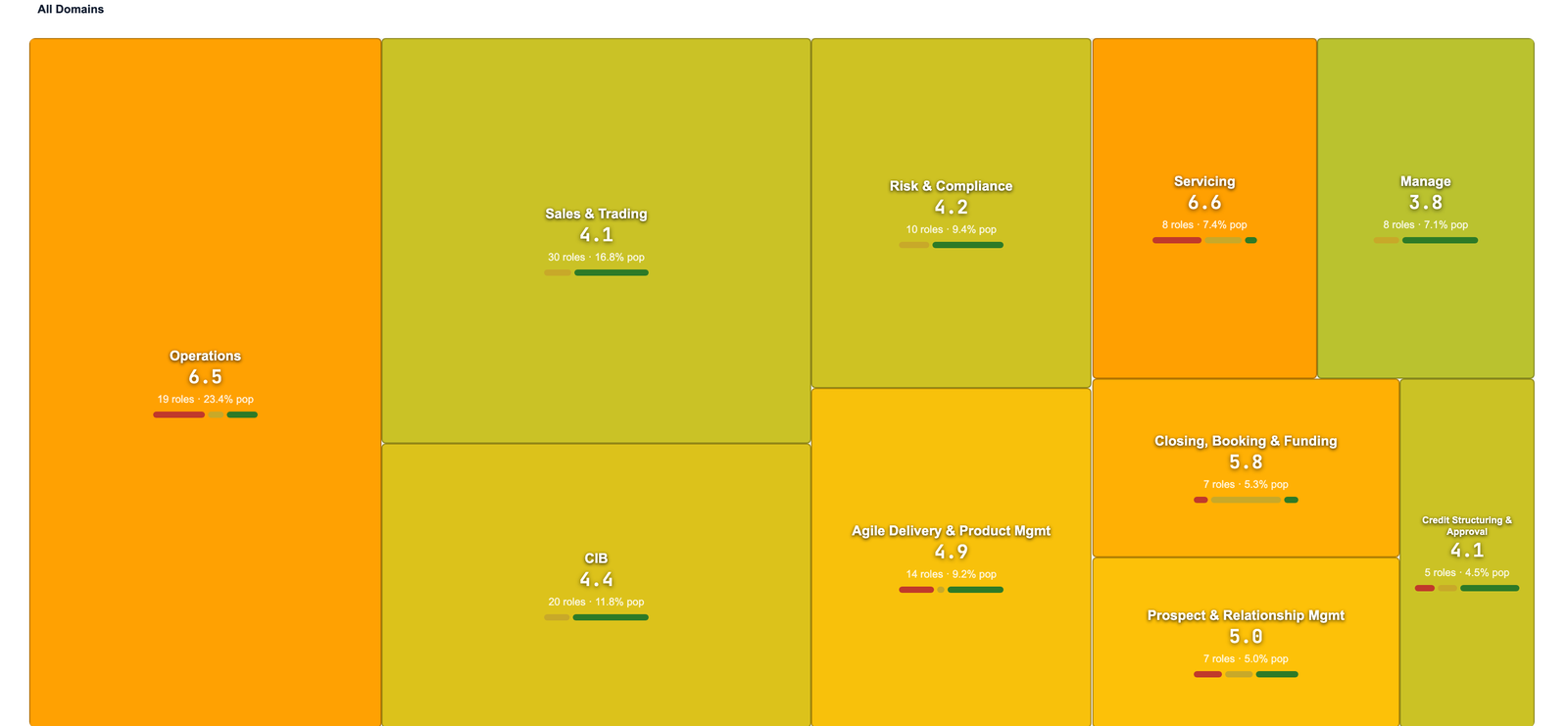
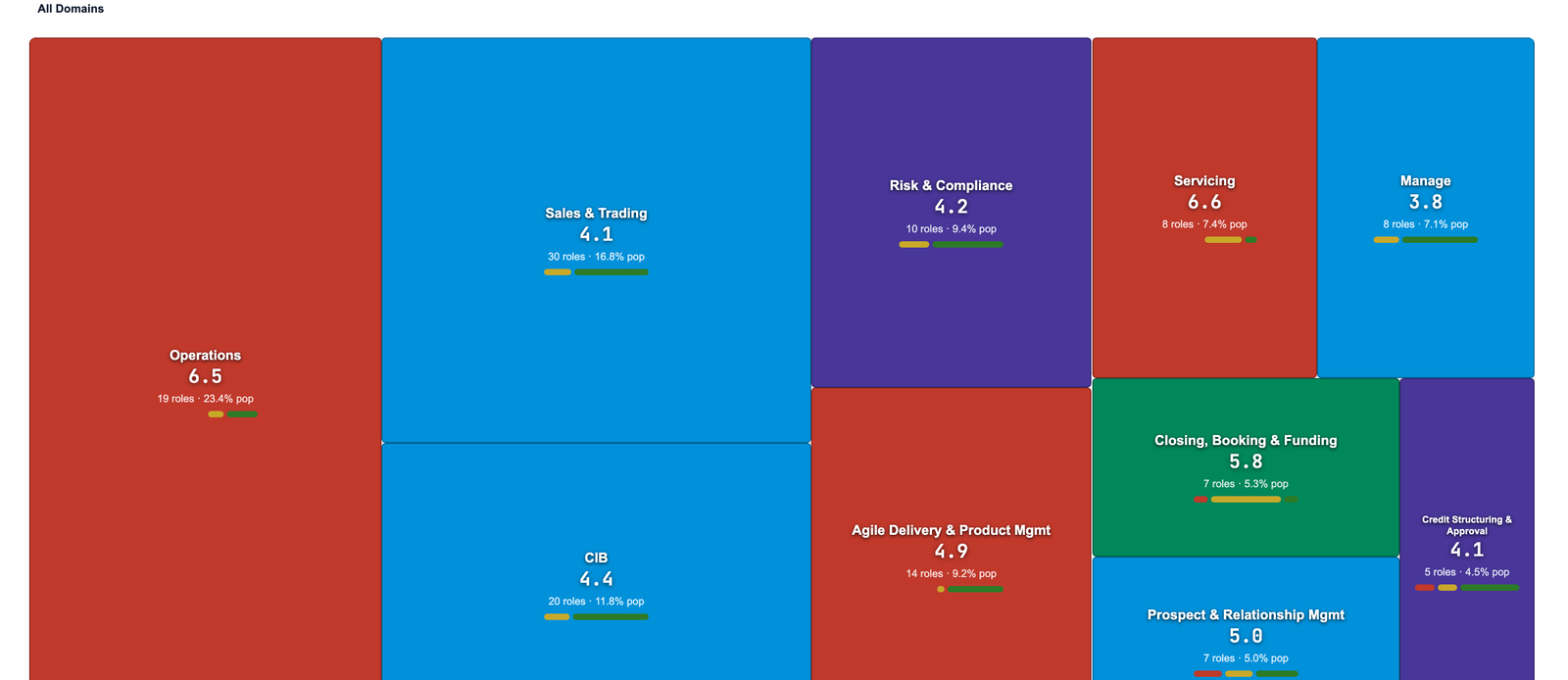
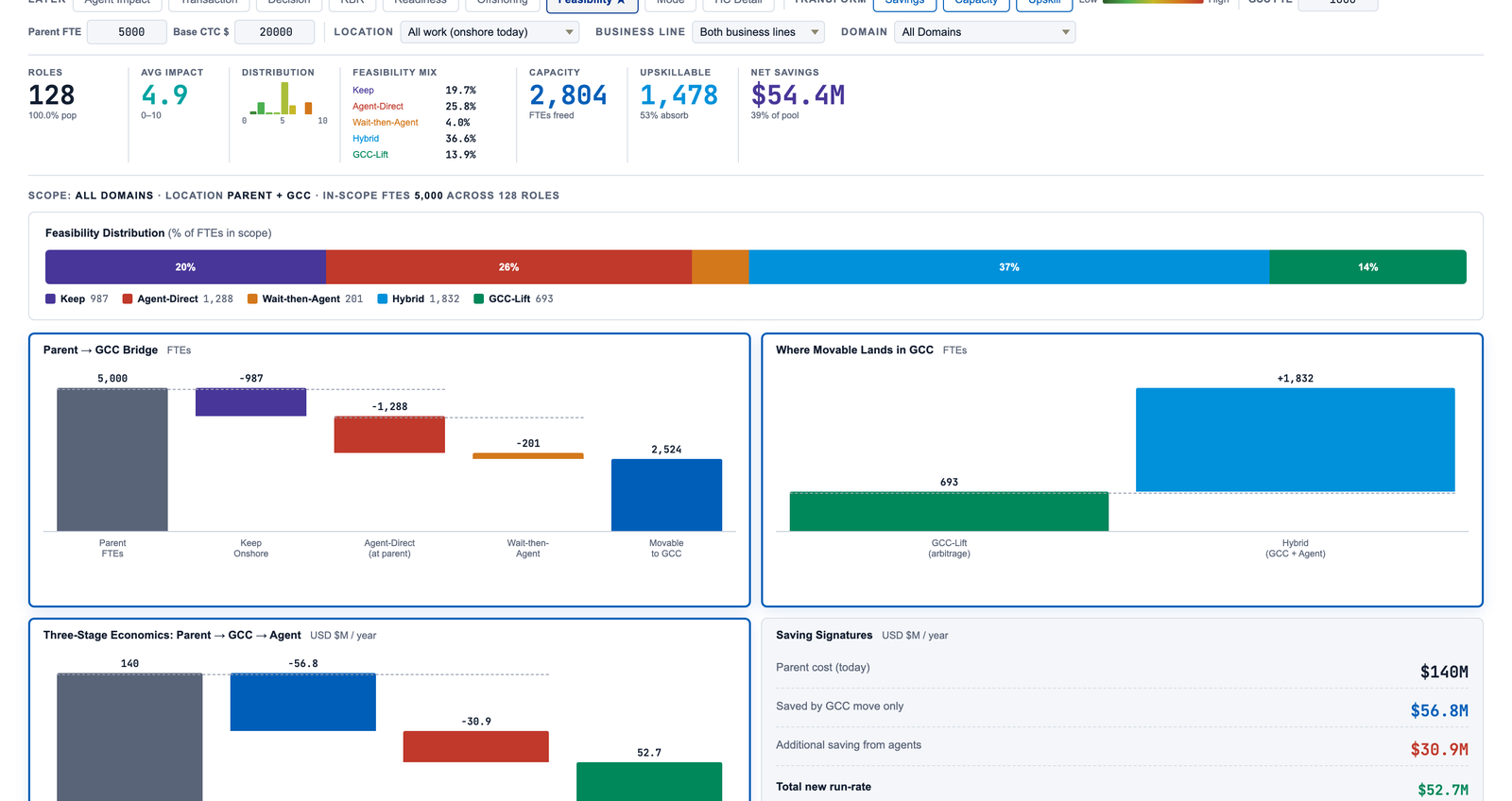
Inside every module the same engine drives a live dashboard. Switch the layer — Agent Impact, Decision, Readiness, Offshoring, Feasibility — and the treemap recolours. Switch the transform — Savings Map, Capacity Released, Economics — and it reads out value.
Filter by GCC size, parent FTEs, cost base, location and department to model your organisation, then read the net savings, capacity released and upskill potential straight off the map.
AgentShift runs along two dimensions. Functions (Finance, HR, Procurement) are horizontal — they apply to any company. Sectors (Banking, Insurance, and more) are whole-GCC industry views. Click a function row or a sector column to open its module.
68 scored agents across 7 domains — Source-to-Pay, Record-to-Report, FP&A, Treasury, Tax — each tiered with effort and value quantification.
The finance operations overview — AP/AR, close management, treasury and FP&A transformation across shared-services models.
54 scored processes across the hire-to-retire lifecycle — role-based agent mapping, decomposition and automation-readiness scoring.
HR shared-services overview — talent acquisition, onboarding, payroll and employee experience across GBS models.
Retail & corporate banking, risk, compliance and operations — a centre-of-excellence agentic transformation map.
Trade operations, settlement, regulatory reporting, risk analytics and client servicing across sell-side and buy-side.
Underwriting, claims, policy administration, actuarial & pricing and distribution across life, P&C and health lines.
Property operations, lease administration, facilities, asset valuation and tenant experience automation.
Merchandising, supply chain, store operations, demand forecasting and direct-to-consumer engagement.
Asset management, field operations, trading, HSE compliance and decarbonization intelligence.